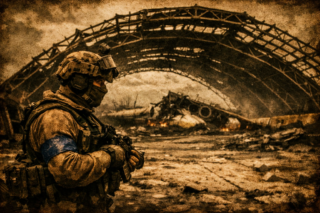
In 480 BC, a number of Greek fighters stood at the narrow pass of Thermopylae, located between the sea and the mountains north of Athens, facing the enormous army of the Persian Empire. Although the details of the battle were not as epic as later conveyed by historians, poets, and filmmakers, the Greeks ultimately lost both the battle and the narrow pass of Thermopylae. The forces of Emperor Xerxes I continued advancing until they entered Athens victorious. Yet despite this clear tactical—and to a lesser extent operational—victory, the battle nevertheless proved a strategic victory for the Greeks.
In that battle, the Greeks avoided an early collapse and spared themselves a chaotic retreat. They gained enough time to evacuate the population from the cities—especially Athens—as well as sufficient time to evacuate their fleet. More importantly, they shattered a dangerous assumption promoted by the invading power: that resistance was futile and that the empire could not be defeated.
As Mark Twain famously observed: “History does not repeat itself, but its events rhyme.”
At dawn on 24 February 2022, only minutes after Russian President Vladimir Putin announced the start of the “special military operation” in Ukraine—which we later came to understand meant a full-scale invasion of Ukrainian territory—3M-54 cruise missiles were launched. A few minutes later, at around 6:00, they struck Base 3018 of the Ukrainian National Guard in the town of Hostomel, 10 km from the city of Kyiv.
This base lies near Hostomel International Airport, a cargo-dedicated facility distinguished by a 3.5 km-long runway—wide and made of reinforced concrete—capable of bearing extremely heavy loads.
Within a few hours of the missile strike, the airport would become the scene of one of the most epic and consequential battles since the beginning of clashes between Russia and Ukraine in 2014—clashes that intensified dramatically with the start of the full Russian invasion that very day.
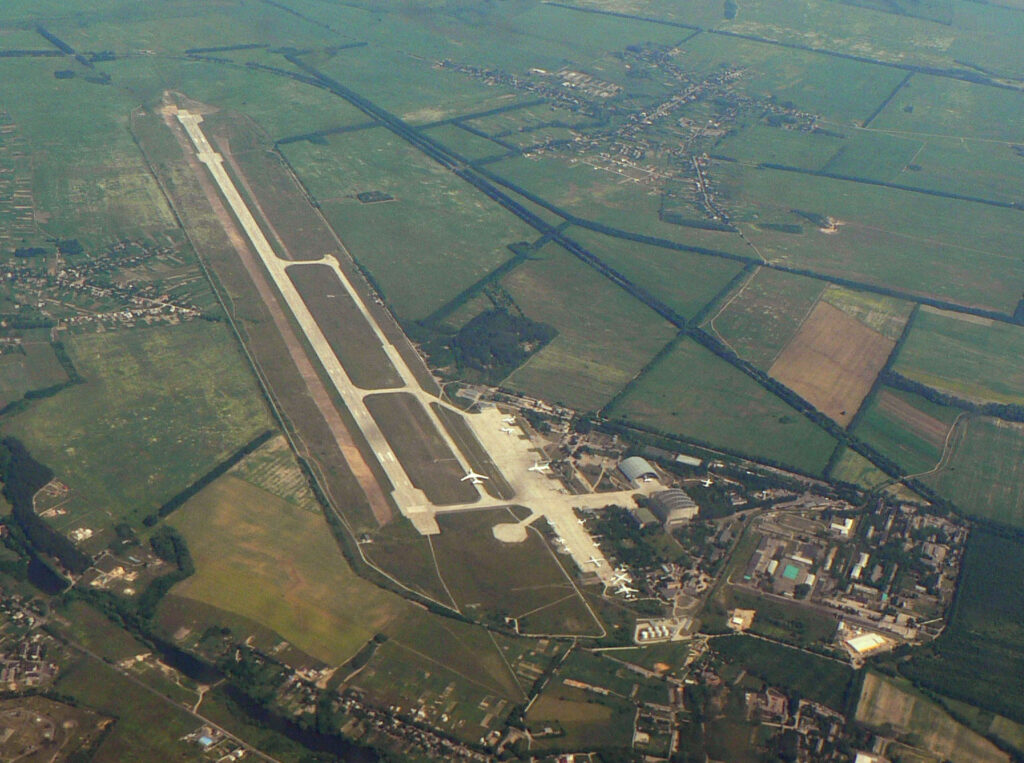
The airport was defended by 200 conscripts performing mandatory service at the targeted National Guard base. Fortunately, they had already been deployed on the airport grounds—though it was not yet clear to anyone that this location represented the tactical keystone of the Russian operation. Most of these conscripts had non-combat roles such as firefighting, administrative work, and guarding. They had no experience of battle or live-fire combat.
The 200 conscripts, led by Vitali Rudinko, were positioned in small groups of 10–12 in defensive positions south of the airport. They were armed with individual weapons and 9K38 IGLA heat-seeking, man-portable anti-aircraft missiles. Twenty conscripts equipped with ZU-23-2 anti-aircraft guns were positioned north of the airport to protect the runway.
The defenders parked the military trucks that had transported them from the base, along with fuel trucks, at equal intervals along the runway as a precaution. They did so without any knowledge, information, or conception of the impossible task awaiting them, or of the Russian plan targeting them. All available indications to the Ukrainian command suggested that the Russian operation would focus on the Donbas region in eastern Ukraine.
At 9:00, about 170 km north of Hostomel, a large group of Russian helicopters took off from Bokov airport in Belarus, heading south toward Ukraine. Flying at low altitude to avoid radar detection, they crossed the Belarusian-Ukrainian border successively at around 9:30, hugging the Dnipro riverbed just above the water’s surface. The raiding force included no fewer than 34 aircraft: 20 Mi-8 transport helicopters carrying airborne troops, protected by 10 modern Ka-52 attack helicopters, along with several older Mi-24 and Mi-28 helicopters.
These aircraft carried approximately 300 soldiers, most of them from the 31st Guards Air Assault Brigade and the 45th Special Forces Brigade—elite Russian units well known in military circles.
When the first aircraft reached the hydroelectric power station north of Kyiv, they veered west away from the river toward the airport. One after another, they flew into view of local residents and Ukrainian soldiers stationed at the power station, who were still unaware of the broader operation, the tightly coordinated Russian plan, or the overarching strategy aimed at subjugating Ukraine within days. The Ukrainians opened fire with the weapons they had, managing to bring down one helicopter into the water and forcing another to make an emergency landing.
Most of the attacking force, however, arrived in two main groups: one to the north of the airport to seize the radar—where the 20 conscripts with anti-aircraft guns were positioned—and the other to the south, where the hangars, buildings, and barracks were located, and where the remaining 180 conscripts were dispersed with light weapons and IGLA launchers designed in 1971. The battle for the airport began at exactly 11:00.
Before the battle, at the Ukrainian military operations headquarters, and minutes after 9:30—when the helicopters first appeared north of Kyiv—Ukrainian commanders, junior and senior alike, grasped the true dimensions of the Russian plan. At the same time, they recognized the error of their earlier assessments and the magnitude of the looming catastrophe. This was not the first time experienced commanders familiar with Soviet and Russian doctrine had encountered such a tactic.
It was the same plan the Soviets used to suppress the Prague Spring in 1968, the same plan employed by the Soviet army to occupy Kabul in 1979, and likewise the plan the Russians used to complete the occupation of the Ukrainian Crimean Peninsula in 2014.
The Russian plan can be summarized as a special military operation in three stages. In the first stage, airborne forces would seize the airport, secure its surroundings, and open the runway. In the second stage, military transport aircraft would deliver 1,000 fighters along with their armored vehicles, enabling the occupation of Kyiv and the killing, kidnapping, or subjugation of Ukraine’s political and military leadership. In the third stage, ground forces would arrive by the end of the day, establishing supply lines between Russian units in Kyiv and those advancing from Belarus.
This would ultimately force Ukraine to surrender militarily and accept Russian conditions, whatever they might be. The war would end in three days, in a lightning-fast campaign, and Putin’s name would be recorded in Russian history as the leader who restored Russia’s glory and control over Ukraine—the cradle of its identity and culture—lost after the dissolution of the Soviet Union.
At that moment, nothing separated the Russian president from this lofty ambition except 200 conscripts specializing in firefighting, gate guarding, and bureaucratic office work—whom fate had placed as an obstacle before the sweeping flood.
The Ukrainian military administration quickly issued orders to nearby forces to save the airport, Kyiv, and Ukraine itself. The 80th and 95th Air Assault Brigades were dispatched from Zhytomyr, along with the 72nd Mechanized Brigade from Bila Tserkva. They began moving rapidly toward Hostomel with the help of civilians who assisted in transporting troops and ammunition—what the brigade commander later called “the march of life.” However, these forces would not begin arriving at the airport until 13:00.
The airport battle began at 11:00 with attack helicopters raiding the defenders south of the airport using unguided rockets and machine guns, concentrating fire on airport buildings. At the same time, the defenders fired from every direction at the aircraft, managing to shoot down a Ka-52 attack helicopter with an IGLA missile, which exploded on the runway. Two more helicopters of the same type followed, as well as a Mi-24 south of the runway and a Mi-8 that was attempting to land to disembark soldiers.
The intensity of the fighting, the density of fire, and the thick black smoke rising from burning buildings, aircraft, and trucks delayed the disembarkation of airborne forces from the remaining Mi-8 helicopters.
Under sustained pressure, and with their IGLA missiles running out, the remaining Ukrainian conscripts withdrew south of the airport, taking shelter among buildings and trees. This allowed transport helicopters to land north of the runway and begin disembarking troops to seize the radar installation, and the first Ukrainian soldiers were taken captive. Russian forces continued landing on the airport grounds and pushing the Ukrainians away from the runway.
Fighting continued in the buildings south of the airport. Due to the ferocity of the assault, the attackers’ experience, and dwindling ammunition, the remaining conscripts withdrew further toward the airport perimeter.
At exactly 13:00, the Russian flag was raised on an airport building—more than an hour and a half later than the tightly scheduled Russian plan had anticipated. The Russians won this tactical engagement and forced the Ukrainians back. Yet the steadfast resistance of those 200 conscripts for two full hours was enough to alter the course of history. During those two hours, Ukrainian reinforcements began arriving around the airport, one after another, to attack the Russian aggressor with whatever means they had.
Fighting paused briefly as Russian forces attempted to clear debris from the runway.
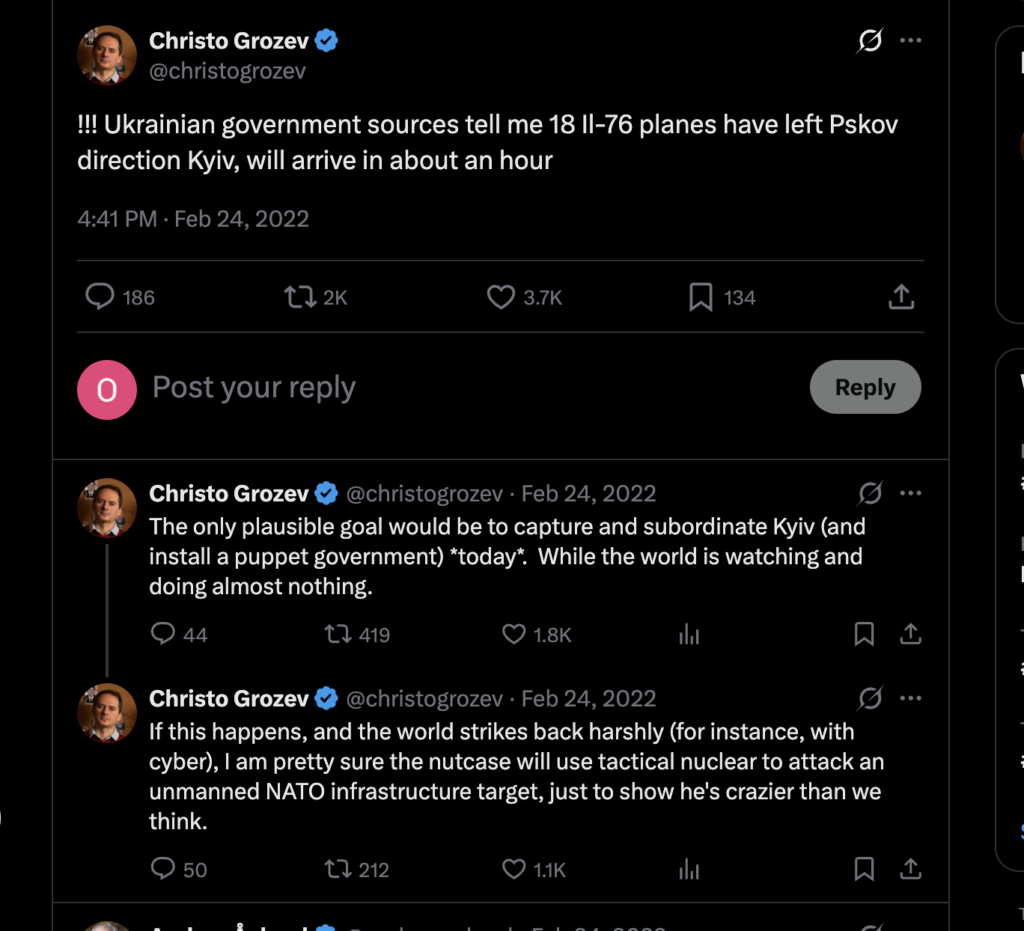
Meanwhile, according to the second phase of the plan, 18 Russian Il-76 transport aircraft took off from Pskov military airport in Russia, 800 km north of Kyiv. They carried a total of 1,000 soldiers from the highly ready 76th Guards Air Assault Brigade and were headed for the runway at Hostomel—approximately two hours away by air.
At the same time, Russian ground forces that had launched the invasion earlier that day advanced through the uninhabited Chernobyl exclusion zone, evacuated for decades due to the nuclear disaster.
At 15:00, once the airport was fully encircled, President Zelensky gave the order to liberate it. Ukrainian artillery opened fire, targeting the distinctive runway and inflicting severe damage across its surface, leaving deep shell craters. Transport aircraft can land only on intact, smooth runways. With every shell that struck the concrete, the chances of the Russian operation—and of Putin’s strategic plan—diminished. The Russians were forced to cancel the airborne landing after the Il-76s had flown two-thirds of the way, diverting them to an airport in Belarus.
The only remaining hope for the Russian force at the airport was the arrival of mechanized ground forces advancing from the north. What those troops did not yet know was that the long armored column had become trapped in a logistical nightmare south of Chernobyl, where Ukrainian soldiers inflicted severe losses through well-prepared ambushes along the road. The ground forces would not reach the airport until the following morning.
At 21:00, after fierce fighting, the entire airport returned to Ukrainian control. The battle for the airport ended. The next day, mechanized Russian forces reached the airport perimeter, and Ukrainian troops withdrew after striking the runway one final time to render it permanently unusable.
After withdrawing, Ukrainian forces established a defensive line running through the municipality of Hostomel and neighboring towns to defend Kyiv. This line successfully halted the Russian advance toward the capital and inflicted heavy losses until Russian forces withdrew from north of Kyiv in early April 2022. The airport and all territory north of Kyiv up to the Belarusian border returned to Ukrainian hands.
On 24 February 2022, the Battle of Antonov Airport in the town of Hostomel, 10 km from the capital, Kyiv, “rhymed” with the Battle of Thermopylae. Time and place differed; weapons and tactics differed; yet the story and the grand strategy were strikingly similar: a limited defending force, inferior in numbers and equipment, facing a rapid and shocking invasion by a great-power army seeking to break resistance and impose its will. As at Thermopylae, Antonov Airport became the point at which months of Russian propaganda about the inevitability of victory and the futility of Ukrainian resistance collapsed.
Two and a half millennia separate the Battle of Thermopylae from the Battle of Antonov Airport—yet how striking is the “rhyme” between the two events.
Just as Thermopylae proved a strategic loss for the Persian Empire, the Battle of Antonov Airport can be seen as a resounding strategic defeat for the aggressor, the Russian Federation—one that has cost it dearly from that day to the moment of writing this article, which I have carried in mind for two years. It shattered, in the Ukrainian public imagination, the myth of inevitable Russian victory; restored confidence in Ukraine’s armed forces; and renewed faith in President Zelensky, who did not flee but remained in his capital during its darkest hours. Even when the United States reportedly offered to evacuate him to safety, he replied: “I need ammunition, not a ride.” A choice that stood in stark contrast Mr. Assad who chose flight over fight.