Those who know me well know that I do not particularly like social media. I try to avoid it in my private life, I try to keep as much distance as possible, but it was not always this way. I was, in fact, an early adopter. I joined Facebook around 2006, when the idea of social-media platforms was still young and almost innocent. At the time, I found in Facebook a way to remain connected to friends and family I left behind in pursuit of further education.
Then came the Arab Spring carrying hopes of rebirth after long political winters.
Social media, especially Facebook and Twitter, played a central role in that moment. Without those platforms, the Arab Spring may not have arrived when it did. Those days. I thought of Social media as a great triumph for freedom of speech, and hence democracy.
These days, after two decades of watching social media evolve, and after moving through different stages in my relationship with it — from ordinary user, to experienced user, to someone increasingly interested in the relationship between social media and societies and actively involved in related research project — I have reached a set of convictions. I offer the first of them here as an invitation to think: Social media is incompatible with democracy.
Freedom speech is not freedom of reach
Democracy depends on freedom of speech. This is treated almost as a sacred principle, and rightly so. A democratic society cannot exist if citizens are not free to criticize power, argue about public affairs, organize politically, and persuade one another. But hidden inside our modern understanding of “Freedom of Speech”, is another concept that we rarely examine: “Freedom of Reach”. These two concepts are not the same.
Freedom of speech, as a democratic principle, was conceived in a world where speech was mostly local, embodied, and limited. A person could speak in a town hall, in a market square, in a meeting, then in a newspaper, in a pamphlet, and recently on radio and television. Each expansion of reach changed politics. Each one disturbed society. Each one created new forms of power.
For instance, the printing press did not merely allow more people to speak. It allowed ideas, accusations, rumors, and hysteria to travel farther and faster than before. Printed pamphlets and books helped spread religious conflict, revolutionary ideas, conspiracy thinking, and persecutions, including the panic around witchcraft in early modern Europe. In the age of the printed word, the ability to read, the language barrier, and the availability and price of printed material was still a limiting factor. Radio was another jump in reach, that in many ways changed mass mobilization. Televisions changed leadership and image. Over the eras, “reach” was never neutral. When reach expanded, societies were shaken.
The advent of the internet and particularly of Social Media represents the most radical expansion of “reach” in human history.
For the first time, almost every individual can potentially speak to almost everyone else, instantly, cheaply, repeatedly, and across borders. This is presented as a victory for freedom. But after much deliberation, and debate, I believe that, for democracy, it may eventually be a disaster.
Social Media destroys the boundaries of political communities
Democracy is not simply “everyone talks.” Democracy is a system in which a political community governs itself. That community has boundaries. Citizens argue, vote, compromise, and live with the consequences. The legitimacy of the democratic process depends on the fact that those participating in the political decision are also those affected by it.
Social media destroys that boundary.
A British citizen arguing about Brexit is part of the political community that must live with the result. But an English-speaking person in Russia, the United States, India, or anywhere else can also participate in the same discussion, amplify one side, ridicule the other, spread slogans, provoke anger, and shape the emotional climate around the debate. That person does not vote in the referendum. That person does not live under the consequences. Yet through social media, they can still participate in the political atmosphere that surrounds the decision.
The same problem appears everywhere. In a small Arabic-speaking country such as Lebanon, a national debate about Hezbollah does not remain Lebanese. The entire Arabic-speaking world can pour into the conversation. People from countries with different histories, interests, wounds, regimes, and strategic agendas can intervene in a domestic Lebanese dispute. They can praise, condemn, inflame, mock, threaten, and polarize. But they do not all live inside the social fractures they help deepen.
This is not democratic participation. It is political pollution.
Democracy assumes that political speech happens primarily among members of a political community. Social media makes that assumption false. It allows outsiders, non-citizens, foreign activists, ideological tribes, diasporas, propaganda networks, bots, intelligence services, and adversary states to enter domestic debates as if they were ordinary participants.
The result is not a larger public square. It is a borderless battlefield.
A citizen may have the right to speak. But does every person on earth have the right to reach millions of citizens inside another democracy during an election, referendum, protest movement, constitutional crisis, war debate, or national tragedy?
Does a hostile state have a right to participate in the emotional formation of another country’s electorate?
Does a foreign influencer have a democratic right to help radicalize a public they will never be accountable to?
Does a platform have the right to decide, silently and at scale, which voices in a national debate are amplified and which are buried?
These are not technical questions about algorithms or such. They are questions that are of the utmost concern to democracy.
Democracy needs a bounded political community. Social media creates unbounded political intervention. Democracy needs citizens who argue while sharing consequences. Social media empowers participants who carry no consequences. Democracy needs a public sphere. Social media creates the public squares but allows foreign influence in, and even artificial crowds.
This is not only about bots, although bots make it worse. It is not only about artificial intelligence, although AI will make it far worse. It is not only about algorithms, although platforms use ranking systems to control attention. Bots, AI and algorithms are accelerants, not the fire itself.
When people discuss Brexit, the rise of the far right in Europe, political radicalization, sectarian polarization, or the collapse of trust in institutions, they often ask what role social media played. But the more important question may be whether democracy can survive a communication system that allows every domestic political conversation to be invaded, amplified, distorted, and emotionally occupied by actors outside the democratic community.
Goals of Social media companies cannot be aligned with the goals of every democratic country
At the moment, social-media companies control reach. They decide who is visible and who is not. They decide which posts travel and which posts die. They decide what becomes a national obsession and what disappears. They may call this moderation, recommendation, ranking, safety, engagement, or product design. But politically, it is power.
A social-media company does not have one democratic responsibility. It operates across dozens of countries, each with different histories, institutions, conflicts, vulnerabilities, and political values. It cannot be aligned with all of them at once. It cannot protect every democracy, every fragile society, every minority, every election, every peace process, and every public sphere. In many countries, it has little revenue, no physical assets, no deep cultural understanding, and no meaningful stake in the consequences of the chaos it enables. This is a core incompatibility.
The Philippines offers another warning. Rodrigo Duterte’s rise was closely associated with the political use of Facebook, online mobs, and disinformation networks. Maria Ressa and Rappler documented how digital attacks, propaganda, and intimidation became part of the political environment, while Ressa later described the Philippines as an early example of how social-media tactics could be used to weaken democratic norms and strengthen authoritarian politics. Again, the issue is not simply that people lied online. People have always lied in politics. The issue is that platforms made coordinated manipulation cheap, scalable, personalized, and emotionally contagious.
These examples point to the same structural problem. Social-media companies are asked to behave like guardians of democracy while being designed as global attention businesses. Their business requires scale, speed, frictionless sharing, emotional intensity, and constant engagement. Democracy requires context, deliberation, trust, institutional legitimacy, and limits on domination. These goals are not naturally compatible.
A democratic country may need calm before an election. A platform may benefit from outrage. A fragile society may need slower information flows during a period of violence. A platform may reward viral accusation. A minority may need protection from organized dehumanization. A platform may detect the threat only after the damage is done, especially if the language is under-resourced. A democracy may need citizens to inhabit a shared public reality. A platform may profit from dividing them into personalized realities optimized for retention.
This is why the problem cannot be solved merely by demanding “better moderation.” Moderation is important, but it does not address the deeper question: why should a private foreign company have the power to decide the reach of political speech inside a democracy at all? The central issue is not only bad decisions. It is the concentration of public-sphere power in institutions whose incentives, loyalties, and accountability structures are not democratic.
This is the core incompatibility: democracies need communication systems that serve the public sphere, while social-media companies need public spheres that serve their platforms.
Conclusion
Freedom of speech and freedom of reach are not the same thing. Democracies inherited the principle of free speech from a world in which speech was naturally limited by place, scale, cost, literacy, and time. That principle was never seriously tested against a world where every individual could instantly reach millions across borders. But a right to speak does not automatically imply a right to unlimited reach. If democracy is to survive the age of social media, this distinction must be made explicit and examined without illusion.
Social media gives foreign citizens, hostile states, anonymous mobs, commercial platforms, bots, and soon autonomous AI agents the ability to enter the democratic bloodstream. A democracy, in my opinion, cannot remain healthy if its public discourse is permanently open to manipulation by people and institutions that do not belong to its demos. This does not mean censorship is the solution. It means the old vocabulary is inadequate. “Freedom of speech” cannot be used as a lazy slogan to avoid discussing “freedom of reach.” The right to speak and the power to reach are different things. A democratic society may protect the first while regulating, limiting, or at least seriously questioning the second.
The goals of Social-media companies cannot be aligned with the democratic interests of all societies at once, because those societies are different, belong to different jurisdiction and legal frameworks, different cultures and political tradition. A platform operating globally will always optimize for its own institutional logic: growth, retention, influence, legal survival, and profit. It may occasionally coincide with democratic needs in one country, while undermining them in another. This is not a technical bug that can be fixed with better intentions. It is a structural contradiction between global commercial platforms and the particular political needs of self-governing societies.
The optimist will say that societies adapt. They always have. I agree. But it is not clear whether democracies will survive that adaptation. In my opinion, when democracy was designed, the designers did not anticipate the advent of social media. Social media are not merely damaging democratic debate. They may be structurally incompatible with democracy itself. And if democracies do not understand this soon, they may not survive them.
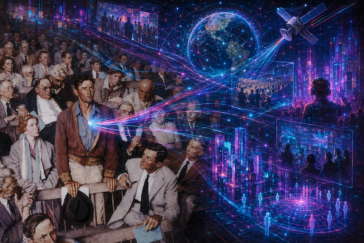
* The featured image AI generated composition using one variant of “Freedom Of Speech” by Norman Rockwell left, and the concept of “Freedom of Reach” and the global nature of Social Media Reach in Cyber-Punk style towards the right.